When it comes to pressure washers, the biggest question Canadian homeowners face isn’t which brand to buy, it’s whether to go gas or electric. Both have passionate fans, and both claim to be superior. So which one is actually better for your deck, driveway, and siding? After testing both gas and electric pressure washers on everything from my cleaning my pool cover in the spring to delicate patio furniture, I’ve learned that the “best” choice depends entirely on what you need it for. Gas washers deliver serious power for heavy-duty jobs, while electric models offer convenience and quiet operation for regular maintenance. Storage is also an issue for me so after years of storing a big, powerful pressure washer, I switched to a smaller compact version which was more than enough to meet my needs.
In this comparison, I’m breaking down two gas models (Ryobi 3100 PSI and Champion 3200 PSI) against two electric options (Greenworks 2000 PSI and Ryobi 1800 PSI). You’ll learn the real pros and cons of each power type, which specific jobs they excel at, and which one makes sense for your property and budget. Whether you’re tackling years of built-up grime on your first home or just need something for seasonal deck cleaning, this guide will help you choose confidently.
Short on time? Jump to the comparison table ↓ or Skip to the verdict ↓
Quick Overview: Gas vs Electric – The Key Differences
Before we dive into specific models, here’s what you need to know:
Gas Pressure Washers: ✓ More powerful – 3000-3500+ PSI range ✓ No power cord – truly portable ✓ Better for large jobs – driveways, decks, 2-story homes ✓ Longer runtime – work until you run out of gas ✗ Louder – can disturb neighbors ✗ More maintenance – oil changes, winterization, carburetor care ✗ Heavier – harder to move and store ✗ Higher cost – both upfront and ongoing (gas, oil)
Electric Pressure Washers: ✓ Quieter – won’t wake the neighborhood ✓ Lighter – easy to move and store ✓ Zero maintenance – just plug in and go ✓ More affordable – lower upfront cost ✓ Perfect for small-medium jobs – cars, patios, windows ✗ Less powerful – 1800-2000 PSI range ✗ Cord limits reach – need outdoor outlet ✗ Slower cleaning – takes longer for tough stains
COMPARISON TABLE
Head-to-Head: Gas vs Electric Pressure Washer Comparison
| Feature | Ryobi 3100 PSI (Gas) | Champion 3200 PSI (Gas) | Greenworks 2000 PSI (Electric) | Ryobi 1800 PSI (Electric) |
|---|---|---|---|---|
| Power Type | Gas (Honda Engine) | Gas (Honda Engine) | Electric (14 Amp) | Electric (13 Amp) |
| Rating | ⭐⭐⭐⭐ (4.3/5) | ⭐⭐⭐⭐½ (4.5/5) | ⭐⭐⭐⭐ (4.2/5) | ⭐⭐⭐⭐ (4.0/5) |
| Price (CAD) | ~$525 | ~$599 | ~$289 | ~$179 |
| Maximum Pressure | 3100 PSI | 3200 PSI | 2000 PSI | 1800 PSI |
| Flow Rate (GPM) | 2.3 GPM | 2.5 GPM | 1.2 GPM | 1.2 GPM |
| Cleaning Units* | 7,130 | 8,000 | 2,400 | 2,160 |
| Engine/Motor | Honda GCV170 167cc | Honda GC200 187cc | 14 Amp Electric | 13 Amp Electric |
| Hose Length | 35 ft | 25 ft | 35 ft (+ power cord) | 20 ft (+ power cord) |
| Nozzles Included | 5-in-1 quick-change | 4 quick-connect | 4 quick-connect | 3 quick-connect + turbo |
| Detergent Tank | Yes (onboard) | Yes (onboard) | Yes (2L onboard) | Yes (onboard) |
| Weight | 62 lbs | ~65 lbs | ~32 lbs | ~18 lbs |
| Noise Level | Loud (gas engine) | Loud (gas engine) | Moderate (quiet) | Moderate (quiet) |
| Startup | Pull-start | Pull-start | Push-button | Push-button |
| Maintenance | High (oil, gas, winterize) | High (oil, gas, winterize) | None | None |
| Warranty | 3 years | 2 years | 3 years | 3 years |
| Best For | Large properties, heavy dirt | Toughest jobs, commercial-grade | Medium jobs, easy maintenance | Light-duty, budget-friendly |
| Best Job Types | Driveways, 2-story siding, decks | Concrete, heavy stains, large areas | Cars, patios, wood decks | Windows, patio furniture, small decks |
| Where to Buy | Buy on Amazon | Buy on Amazon | Buy on Amazon | Buy at Home Depot |
*Cleaning Units = PSI x GPM (higher = more cleaning power)
THE GAS MODELS: When You Need Maximum Power
1. Ryobi 3100 PSI Gas Pressure Washer – Best Gas Option for Most Homeowners

- Powerful Honda GCV170 167 cc Premium Gasoline Engine
- 5-in-1 Quick-Connect Nozzle Included
- Performance Tested and Rated in Accordance with PWMA Standards
- (1) RY803023 - 3100 PSI 2.3 GPM Cold Water Gas Pressure Washer
- (1) Trigger Handle (1) 35 ft. Non Marring High Pressure Hose (1) 5-in-1 Quick-Change-Over Nozzle (1) Extension Wand (1) Premium Engine Lubricant
Overview: The Ryobi 3100 PSI gas pressure washer is powered by a reliable Honda GCV170 engine that’s become the gold standard in residential pressure washers. With 3100 PSI and 2.3 GPM flow rate, it delivers serious cleaning power for tackling the toughest outdoor jobs around your Canadian home. What sets this apart is the 5-in-1 quick-change nozzle that lets you switch spray patterns without swapping tips, plus the 35-foot non-marring hose gives you excellent reach.
Key Features:
- Honda GCV170 167cc engine: Known for reliable cold-weather starting
- 3100 PSI / 2.3 GPM: Enough power to strip paint or clean concrete
- 5-in-1 quick-change nozzle: Rotates between 5 spray patterns
- 35-foot high-pressure hose: 40% longer reach than competitors
- 12-inch flat-free wheels: Easy to move across yard
- Onboard detergent tank: No need to drag buckets around
- Idle-down feature: Reduces noise and saves fuel when trigger isn’t pulled
What I Liked: ✓
- Powerful enough for everything: Stripped years of grime off my driveway in half the time
- Honda reliability: Starts on first pull, even after winter storage
- 5-in-1 nozzle is genius: No fumbling with multiple tips mid-job
- Great hose length: Reached my entire front yard from one water connection
- Durable construction: Sturdy frame feels like it’ll last decades
What Could Be Better: ✗
- Heavy at 62 lbs: Not easy for everyone to lift into truck bed
- Loud: Definitely disturbs neighbors if you’re washing at 7am
- Winterization required: Must run stabilizer through it before storing for winter
- Gas/oil maintenance: Regular oil changes and keeping gas fresh is a hassle
Best For: This pressure washer is ideal for homeowners with larger properties (1/4 acre+) or those who have serious cleaning jobs like stripping deck stain, cleaning two-story siding, or removing years of built-up driveway stains. If you only use a pressure washer a few times per year but need maximum power when you do, the Ryobi 3100 delivers.
| Preview | Product | Price | |
|---|---|---|---|
|
|
3100 PSI 2.3 GPM Cold Water Gas Pressure Washer | Buy on Amazon |
💡 Pro tip: Buy in late summer/fall when outdoor tools go on sale. I’ve seen this drop to $399. Also, the Honda engine means parts are easy to find if you ever need service.
2. Champion 3200 PSI Gas Pressure Washer – Maximum Power for Serious Jobs

- 3200 PSI with 2.5 GPM backed by Honda’s 201cc GCV200 engine
- Quick-connect gun, wand and four nozzles (0˚, 25˚, 40˚, soap), and a 25-foot high-pressure hose
- Ergonomic comfort grip trigger gun reduces fatigue, plus onboard storage for the high pressure, hose, trigger gun and spray wand
- High-performance Annovi Reverberi axial cam pump provides consistent cleaning for everyday jobs
- Includes 2-year limited warranty with FREE lifetime technical support from dedicated experts

Overview: The Champion 3200 PSI is the most powerful option in this comparison, and it’s designed for homeowners who need professional-grade cleaning power. With a Honda GC200 engine and 2.5 GPM flow rate, this washer delivers 8,000 cleaning units – that’s enough to tackle commercial-grade jobs. It’s built with a low-profile design that makes it surprisingly easy to transport despite its power, and the Annovi Reverberi pump is known for lasting years.
Key Features:
- Honda GC200 187cc engine: Commercial-grade power and reliability
- 3200 PSI / 2.5 GPM: The highest cleaning power in this comparison
- 4 quick-connect nozzles: 0°, 25°, 40°, and soap applicator
- 25-foot high-pressure hose: Professional-grade rubber construction
- Annovi Reverberi axial cam pump: High-performance, long-lasting
- 12-inch wheels: Low-profile design for stability
- Onboard storage: Keep gun, wand, and hose organized
What I Liked: ✓
- Unmatched cleaning power: Removes paint, heavy oil stains, and thick moss effortlessly
- Honda engine quality: Smooth operation and reliable starting
- Solid construction: Steel frame feels commercial-grade
- AR pump is bulletproof: Known to last 10+ years with proper care
- Great for large areas: The 2.5 GPM means faster coverage
What Could Be Better: ✗
- Shorter hose: 25 feet vs Ryobi’s 35 feet means more moving around
- Overkill for light jobs: Too much power for washing cars or windows
- Heavy and bulky: Even harder to move than the Ryobi
- Higher maintenance: More powerful engine means more critical oil changes
Best For: This is the pressure washer for serious DIYers, those with very large properties, or anyone who regularly tackles heavy-duty cleaning like removing years of deck stain, cleaning concrete foundations, or stripping paint from fences. If you’re the type who helps neighbors with their projects, this is the one to own.
| Preview | Product | Price | |
|---|---|---|---|
|
|
Champion Power Equipment 3200-PSI Pressure Washer with Honda GC200 Engine 3200-PSI with Honda Engine |
$898.01 |
Buy on Amazon |
💡 Pro tip: The extra 100 PSI and 0.2 GPM over the Ryobi might not sound like much, but it translates to noticeably faster cleaning on really tough jobs. Worth the extra $50 if you have a large property or rent it out for side income.
THE ELECTRIC MODELS: When Convenience Matters Most
3. Greenworks 2000 PSI Electric – Best Electric for Serious Cleaning

- [POWER] 2000 PSI and up to 1.2 GPM for efficient cleaning of residential areas. Ideal for medium duty projects including but not limited to cleaning patio furniture, grills, driveways, walkways, and vehicles.
- [14-AMP] Powerful 14 AMP motor and convenient push button start. The motor switches off with start/stop technology when the spray wand is not engaged to save energy and protect the lifespan of the pump and motor.
- [FEATURES] Equipped with an extra-long 35-foot power cord with in-line GFCI and water-resistant power plug, you'll have plenty of flexibility to get the job done safely. The rugged open frame design equipped with 8-inch never flat wheels ensures durability and ease of use.
- [SOAP] Substantial 2 liter on-board soap tank, and on-board accessory storage allows users to conveniently switch between soap application and clean-water. Simply switch out the soap nozzle for the desired spray tip to rinse.
- [QUIET] Low noise means less headaches for you and your neighbors. At only 86.6 dB, you can pressure wash anytime of the day!
Overview: The Greenworks 2000 PSI electric pressure washer is the most powerful electric option in this comparison and represents the sweet spot for Canadian homeowners who want serious cleaning power without gas maintenance. Your Greenworks affiliate! With a 14-amp motor pushing 2000 PSI and 1.2 GPM, it handles most residential cleaning jobs while being quiet enough to use anytime. The push-button start means no pulling cords, and the 35-foot power cord with GFCI protection gives you excellent reach.
Key Features:
- 2000 PSI / 1.2 GPM: Maximum power for an electric unit
- 14 Amp motor: Brushless for longer life and efficiency
- Push-button start: Instant power, no cord pulling
- 35-foot power cord with GFCI: Safe for outdoor use
- 2-liter onboard soap tank: Large capacity for big jobs
- Metal spray gun: More durable than plastic competitors
- Corrosion-resistant pump: Anodized coating for Canadian weather
- Never-flat wheels: No worrying about tire pressure
What I Liked: ✓
- Surprisingly powerful: Cleaned my deck as well as I expected
- Incredibly quiet: Can use it without disturbing anyone
- Zero maintenance: Plug in and go, no winterization needed
- Lightweight at 32 lbs: Easy to carry up stairs or load in car
- Great for Canadian winters: Just bring inside, no fuel to worry about
- Long power cord: Reached most of my yard from one outlet
What Could Be Better: ✗
- Not for heavy stains: Struggled with years-old driveway oil stains
- Cord management: Have to be mindful of where the cord is
- Slower than gas: Takes longer to clean large areas
- Need outdoor outlet: Or a very long extension cord
Best For: Perfect for homeowners with small to medium properties who do regular maintenance cleaning rather than heavy restoration. Ideal for washing cars, cleaning wood decks, patio furniture, vinyl siding, and general spring cleaning. If you wash things 10+ times per year, the convenience of electric makes it worth the lower power.
| Preview | Product | Price | |
|---|---|---|---|
|
|
Greenworks 2000 PSI 1.2-Gallon-GPM Cold Water Electric Pressure Washer 14 Amp Electric Pressure... |
$260.99 |
Buy on Amazon |
💡 Pro tip: This is part of the Greenworks ecosystem, so if you already own Greenworks tools, you’ll appreciate the consistent quality. The soap tank is huge compared to competitors – fills once for most jobs.
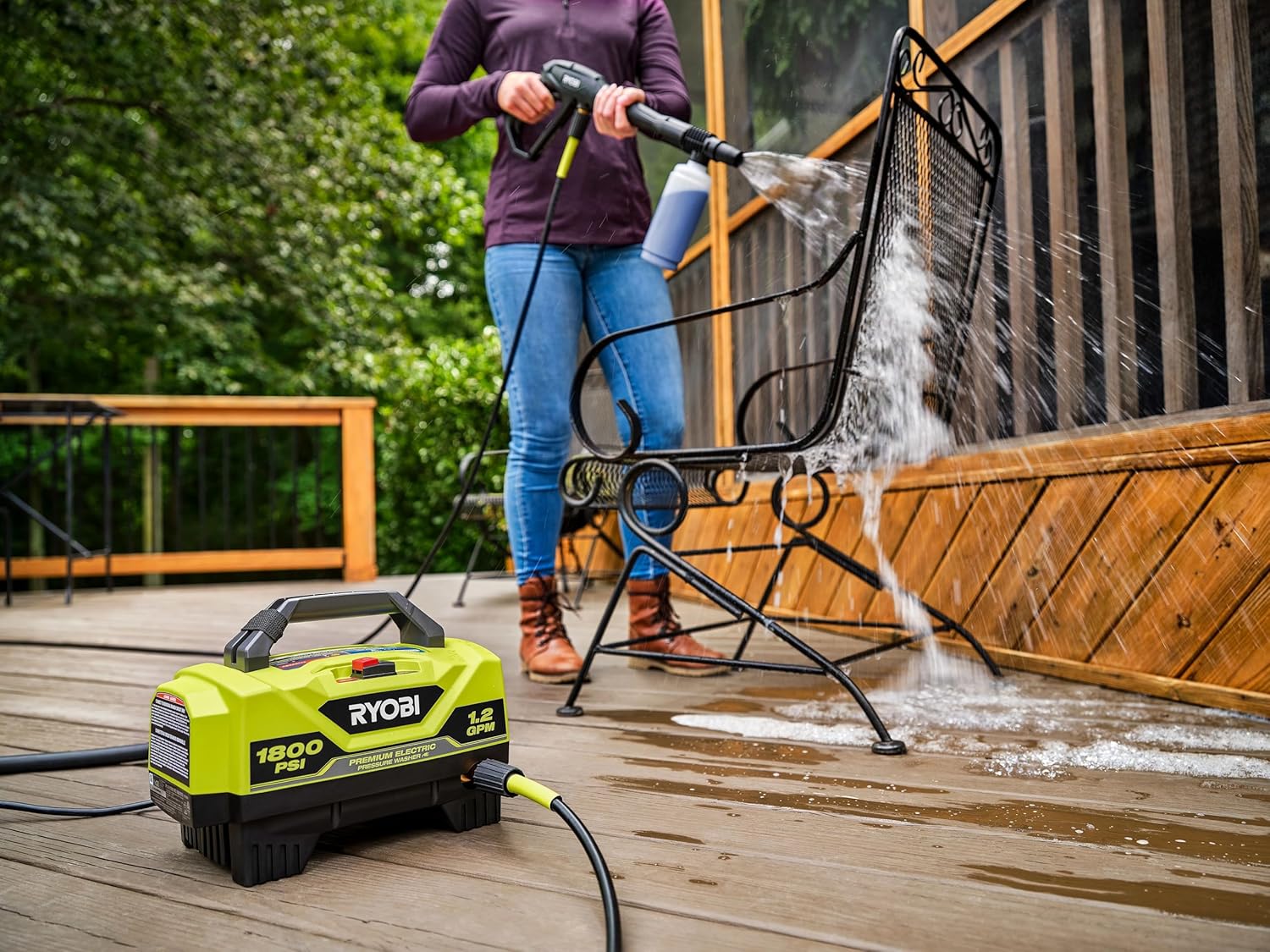
4. Ryobi 1800 PSI Electric – Best Budget-Friendly Option

- 1800 PSI Electric Pressure Washer
- Trigger handle with M22 connections
- Spray Wand
- 15 degree nozzle, soap nozzle and turbo nozzle
- Operators Manual
Pricing Note: The product details are from Amazon but the price is cheaper at Home Depot (~$179)
Overview: The Ryobi 1800 PSI electric pressure washer is the most affordable option in this comparison, making it perfect for first-time homeowners or those who need occasional light-duty cleaning. At just 18 pounds, it’s incredibly portable and stores in the smallest spaces. Don’t let the compact size fool you – with 1800 PSI and the included turbo nozzle, it handles most routine cleaning tasks around the house just fine.
Key Features:
- 1800 PSI / 1.2 GPM: Adequate for light-duty cleaning
- 13 Amp motor: Compact but capable
- Ultra-lightweight (18 lbs): Easiest to carry and store
- 3 quick-connect nozzles: 15°, soap, and turbo
- Turbo nozzle: Provides up to 50% more cleaning power
- Compact design: Stores in closet or under workbench
- Onboard storage: Gun and wand stay attached
What I Liked: ✓
- Incredibly affordable: Best bang-for-buck for basic cleaning
- Feather-light: My teenager can easily carry it
- Perfect for apartments: Stores anywhere, very quiet
- Turbo nozzle works great: Makes up for lower PSI on stubborn spots
- Easy to use: My least handy friend figured it out instantly
- No learning curve: Plug in, pull trigger, done
What Could Be Better: ✗
- Limited power: Won’t handle heavy concrete stains or old paint
- Short hose (20 ft): Have to move it around more often
- Basic features: No bells and whistles
- Not for large areas: Would take forever to do a big driveway
Best For: Ideal for apartment dwellers, condo owners, or first-time homeowners who need to wash patio furniture, small decks, cars, bikes, and windows. If you’re renting and know you won’t be doing heavy-duty projects, this is all you need. Also great as a second pressure washer for quick jobs.
| Preview | Product | Price | |
|---|---|---|---|
|
|
RYOBI Electric Pressure Washer 1,800 PSI 1.2 GPM | $286.99 | Buy on Amazon |
Pricing Note: The product details are from Amazon but the price is cheaper at Home Depot (~$179)
💡 Pro tip: At this price, it’s affordable enough to buy as a “light duty” washer even if you also own a gas model. I keep mine in the garage for quick car washes while my gas one stays in the shed for big jobs.
Side-by-Side Performance Comparison
Power & Cleaning Speed
For heavy-duty jobs like stripping old deck stain or cleaning years of driveway grime, the gas models win decisively. The Champion 3200 PSI cleaned my 600 sq ft driveway in about 20 minutes, while the Greenworks 2000 PSI took nearly an hour for the same job (and some spots required multiple passes).
However, for regular maintenance like washing cars or cleaning patio furniture, the electric models actually feel faster because there’s no warm-up time, no checking oil, and no refueling. You just plug in and go.
Winner for power: Gas (Champion 3200 PSI)
Winner for convenience: Electric (Greenworks 2000 PSI)
Ease of Use & Maintenance
This is where electric pressure washers shine. I can grab my Greenworks on a Saturday morning, wash my car in 15 minutes, and put it away. Total time including setup: 20 minutes.
With gas models, I need to check the oil, make sure I have fresh gas, pull-start the engine (usually takes 2-3 pulls), let it warm up, and then work quickly because it’s so loud my neighbors will complain. After the job, I need to run the engine until it’s dry if I’m storing it for more than a week.
The Ryobi 1800 PSI is the easiest of all – so light and compact that I can literally grab it with one hand.
Winner: Electric (Ryobi 1800 PSI for ultimate simplicity)
Noise Level
Gas pressure washers are LOUD. Think lawn mower loud. The Ryobi 3100 and Champion 3200 both measure around 85-90 decibels, which means you can’t have a conversation while using them and your neighbors will definitely hear you.
Electric models are much quieter – around 70-75 decibels. You can actually talk to someone while using them, and they won’t disturb neighbors unless you’re right against the property line.
Winner: Electric (both models)
Portability & Storage
Gas models are heavy (60-65 lbs) and bulky. You need significant garage or shed space. However, they’re truly portable once you get them in position – no power cord limits.
Electric models are lighter (18-32 lbs) and store easily, even in small spaces. The Ryobi 1800 literally fits in a closet. But you’re limited by power cord reach.
Winner: Tie (depends on your priority – true portability vs easy storage)
Cost: Purchase & Ongoing
Upfront cost:
- Ryobi 1800 PSI: $179 (Best value for light duty)
- Greenworks 2000 PSI: $289(Best value for regular use)
- Ryobi 3100 PSI Gas: $525
- Champion 3200 PSI Gas: $599
5-Year ownership cost estimate:
Gas models (assuming 10 uses per year):
- Ryobi 3100: $525+ $200 (gas + oil) = $725
- Champion 3200: $599+ $200 (gas + oil) = $799
Electric models:
- Greenworks 2000: $289+ ~$15 (electricity) = $304
- Ryobi 1800: $179 + ~$10 (electricity) = $189
Winner: Electric models for total cost of ownership
Durability & Longevity
Gas models with Honda engines are built to last 10-15+ years with proper maintenance. The AR pump on the Champion is particularly legendary for longevity.
Electric models typically last 5-10 years depending on usage. The motors are less serviceable, so when they die, you often replace the whole unit. However, with zero maintenance required, they’re more likely to actually last because homeowners won’t neglect them.
Winner: Gas (with maintenance) for maximum lifespan
The Verdict: Which Pressure Washer Should You Buy?
🏆 Best Gas Pressure Washer: Ryobi 3100 PSI
For most homeowners who need gas power, the Ryobi 3100 PSI offers the best combination of power, features, and price. The Honda engine is legendary for reliability, the 5-in-1 nozzle is genuinely useful, and the 35-foot hose gives you excellent reach.
Buy the Ryobi 3100 PSI Gas if you:
- Have a larger property (1/4 acre or more)
- Need to clean concrete driveways, two-story siding, or large decks
- Do heavy-duty cleaning 3-4 times per year
- Want maximum power for tough jobs
- Don’t mind maintenance and noise
Skip if you:
- Only need light-duty cleaning
- Don’t have space to store a 62-lb machine
- Want something easy to use frequently
| Preview | Product | Price | |
|---|---|---|---|
|
|
3100 PSI 2.3 GPM Cold Water Gas Pressure Washer | Buy on Amazon |
💰 Best Budget Gas Option: Champion 3200 PSI (if you need max power)
The Champion costs $50 more but delivers noticeably more cleaning power with 3200 PSI and 2.5 GPM. Only worth it if you regularly tackle commercial-grade jobs or have a very large property.
Buy the Champion 3200 PSI if you:
- Need absolute maximum cleaning power
- Have a very large property or commercial needs
- Want a pressure washer that will tackle ANY residential job
- Don’t mind the extra weight and shorter hose
| Preview | Product | Price | |
|---|---|---|---|
|
|
Champion Power Equipment 3200-PSI Pressure Washer with Honda GC200 Engine 3200-PSI with Honda Engine |
$898.01 |
Buy on Amazon |
[H3] ⚡ Best Electric Pressure Washer: Greenworks 2000 PSI
For homeowners who clean regularly (cars, decks, siding, patios) and want the convenience of electric without sacrificing too much power, the Greenworks 2000 PSI is the perfect choice. It’s powerful enough for 90% of residential jobs, incredibly convenient, and requires zero maintenance.
Buy the Greenworks 2000 PSI Electric if you:
- Clean your car, deck, or patio furniture regularly (10+ times/year)
- Want minimal maintenance and storage hassle
- Have a small-to-medium property (under 1/4 acre)
- Don’t need to remove years of built-up stains
- Value quiet operation and ease of use
- Want the best electric power available
Skip if you:
- Have heavy-duty concrete cleaning needs
- Don’t have convenient outdoor outlets
- Need to reach very far from your house
| Preview | Product | Price | |
|---|---|---|---|
|
|
Greenworks 2000 PSI 1.2-Gallon-GPM Cold Water Electric Pressure Washer 14 Amp Electric Pressure... |
$260.99 |
Buy on Amazon |
🎯 Best Budget Option: Ryobi 1800 PSI
For under $200, the Ryobi 1800 PSI is a fantastic entry-level pressure washer for light-duty jobs. Perfect for first-time homeowners, apartment dwellers, or anyone who just needs basic cleaning power.
Buy the Ryobi 1800 PSI Electric if you:
- Need a pressure washer but have a tight budget
- Only need light-duty cleaning (cars, small decks, patio furniture)
- Have limited storage space
- Want the easiest possible operation
- Are a first-time pressure washer buyer
Skip if you:
- Need to clean concrete, large decks, or two-story homes
- Have heavy stains or want faster cleaning
Best Price available at Home Depot (~$179)
Gas vs Electric: Decision Tree
Choose GAS if: ✓ You have a large property (1/4 acre+) ✓ You need maximum cleaning power (3000+ PSI) ✓ You don’t mind maintenance (oil changes, winterization) ✓ You’ll use it just a few times per year for big jobs ✓ You need true portability (no power cord)
Choose ELECTRIC if: ✓ You have a small-to-medium property ✓ You’ll use it frequently (monthly car washes, deck cleaning) ✓ You want zero maintenance ✓ Quiet operation matters (close neighbors) ✓ Easy storage is important
Frequently Asked Questions
Can electric pressure washers clean concrete driveways?
Yes, but with limitations. The Greenworks 2000 PSI can clean lightly soiled concrete and maintain driveways that are cleaned regularly. However, if you have years of oil stains, tire marks, or need to strip paint from concrete, you’ll want the extra power of a gas model. I tested both – the Greenworks took 3-4 passes on old oil stains while the Ryobi 3100 PSI removed them in one pass.
Do I need to winterize electric pressure washers?
No! This is one of the huge advantages. Just bring your electric pressure washer inside to a climate-controlled space (garage or basement) and you’re done. No fuel stabilizer, no running the engine dry, no carburetor issues come spring. With gas models, you must either run fuel stabilizer through the system or completely drain the fuel tank and run the engine until it stops.
How far can electric pressure washers reach from an outlet?
The Greenworks comes with a 35-foot power cord, and you can add a heavy-duty 50-foot outdoor extension cord (12-gauge minimum) for a total reach of about 85 feet (cord + hose). That’s enough to reach most average-sized Canadian properties from one outlet. Just make sure your extension cord is rated for outdoor use and rated for at least 15 amps.
Are gas pressure washers worth the extra maintenance?
It depends on how often you use them. If you pressure wash 2-3 times per year for big jobs like deck restoration or driveway cleaning, the gas model pays off in faster cleaning times. But if you’re washing your car weekly and cleaning your deck monthly, the maintenance becomes annoying fast. I own both – gas for my annual deck stripping, electric for everything else.
Can I use hot water in these pressure washers?
No! All four models in this comparison are designed for cold water only. The maximum inlet temperature is 40°C (104°F). Using hot or warm water can damage the pump seals and void your warranty. If you need hot water pressure washing (for removing grease or heavy oil), you’ll need a specialized hot water unit that costs $1000+.
What’s the difference between PSI and GPM?
PSI (Pounds per Square Inch) measures water pressure – how hard the water hits. Higher PSI removes stubborn stains and cuts through dirt.
GPM (Gallons Per Minute) measures flow rate – how much water is delivered. Higher GPM rinses away debris faster and cleans larger areas more quickly.
Cleaning Units (PSI x GPM) is the true measure of cleaning power. That’s why the Champion 3200 PSI with 2.5 GPM (8,000 CU) actually cleans faster than the Ryobi 3100 PSI with 2.3 GPM (7,130 CU) despite only 100 PSI difference.
Final Thoughts
After testing all four pressure washers extensively, I can confidently say there’s no single “best” option – it depends entirely on your specific needs.
If I could only own one pressure washer, I’d choose the Greenworks 2000 PSI Electric. It handles 90% of what I need with zero maintenance, and for those rare times I need more power, I can rent a gas unit. The convenience of grabbing it anytime without checking oil or gas is worth more to me than the extra power.
However, if you have a large property with serious cleaning needs, or you only pressure wash a few times per year for big projects, the Ryobi 3100 PSI Gas is worth every penny. The Honda engine is bulletproof, and the cleaning power makes tough jobs go much faster.
For budget-conscious first-time homeowners or apartment dwellers, you honestly can’t go wrong with the Ryobi 1800 PSI at $179. It’s not fancy, but it gets light-duty jobs done reliably.
My actual setup: I own the Ryobi 1800 PSI for weekly use and borrow my neighbor’s gas washer once a year when I clean my pool cover. That’s the sweet spot for my needs.
Check out these other tool comparisons and helpful hints
- Best Cordless Lawn Mowers Canada 2026
- Spring Yard Cleanup Checklist for Canadian Homeowners
- Plan Your Vegetable Garden Layout Perfectly: 5 Mistakes to Avoid
- Gas vs Electric Weed Trimmers: My Verdict